If you're planning to seal your driveway, one of the first questions you'll likely ask is how long to seal
driveway from start to finish. Whether you're a DIY homeowner scheduling a weekend project or a property
manager planning for minimal disruption, understanding the time commitment is essential. The answer to how
long does it take to seal a
driveway depends on several factors, including driveway size, preparation work,
sealer type, application method, and drying time. This comprehensive guide breaks down every phase so you can plan
your project efficiently.
Why Knowing How Long to Seal Driveway Matters
Understanding how long to seal driveway projects take
helps you:
- Plan your schedule: Block off the right amount of time and arrange alternative parking if needed
- Coordinate with weather: Ensure you have enough dry weather window for application and curing
- Budget accurately: Professional vs. DIY time commitments affect overall project cost
- Set expectations: Know when you can safely use your driveway again
- Avoid mistakes: Rushing leads to poor results; knowing timelines prevents shortcuts
Whether you're asking how long does it take to seal a driveway for a
small residential entrance or a
large commercial property, the principles remain the same—just the scale changes.
Factors That Affect How Long to Seal Driveway
No single answer fits every situation. Here are the key variables that influence total project time when asking
how long to seal
driveway.
Driveway Size and Condition
The most obvious factor is the size of your driveway. A typical single-car driveway (about 300-400 square feet) takes
much less time than a double-wide or extra-long driveway (600-1000+ square feet).
- Small driveway (300-500 sq ft): 2-4 hours for application, plus preparation and drying
- Medium driveway (500-800 sq ft): 4-6 hours for application
- Large driveway (800-1200+ sq ft): 6-8+ hours for application
Beyond size, the condition dramatically affects how long does it take to seal a driveway. A driveway
in good condition with minor cracks can be prepared quickly. A neglected driveway with extensive cracking, oil stains,
or vegetation growth requires significant preparation time—sometimes doubling or tripling the total project duration.
Preparation Requirements
Preparation is the most time-consuming but crucial phase. Skipping or rushing preparation guarantees poor results
regardless of how carefully you apply the sealer.
- Basic cleaning: Sweeping and blowing debris: 30-60 minutes
- Pressure washing: 1-2 hours depending on driveway size and dirt level
- Drying after washing: 24-48 hours (often the longest wait)
- Crack repair: 1-3 hours depending on number and size of cracks
- Oil stain treatment: 30-60 minutes plus drying time for primers
- Masking and protection: 30-60 minutes to protect adjacent surfaces
When calculating how long to seal driveway, many beginners underestimate preparation time. Proper
preparation often takes longer than the actual sealing.
Type of Sealer
Different sealer formulations have different application and drying characteristics that affect total project time:
- Coal tar emulsion: Standard drying between coats (4-8 hours), requires 2 coats
- Asphalt emulsion: Similar to coal tar, sometimes faster drying (3-6 hours between coats)
- Fast-dry acrylic: Quick drying (1-3 hours between coats), ideal for tight schedules
- Commercial grade: May have specific recoat windows that affect timing
The number of coats also matters. Most professionals recommend two coats for proper protection, which effectively
doubles application time and adds drying time between coats.
Application Method
How you apply the sealer significantly impacts how long does it take to seal a driveway:
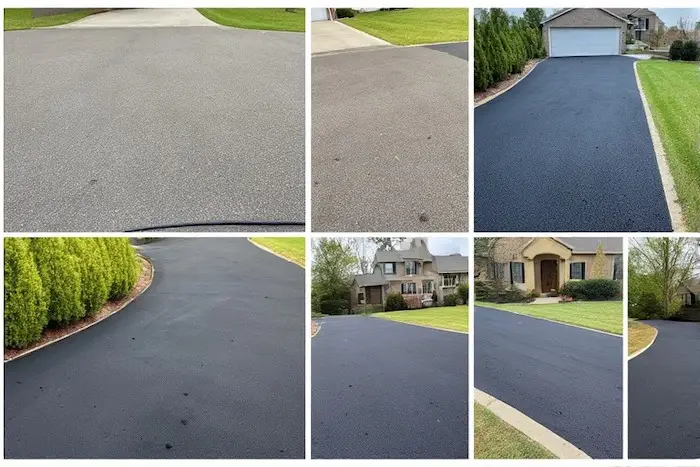
- Squeegee (raclette): The most common method for DIYers and professionals. Provides good control
but requires physical effort. Average application rate: 200-300 sq ft per hour per person.
- Roller: Faster than squeegee for large areas, especially with extension poles. Average: 300-400
sq ft per hour.
- Sprayer: Fastest method but requires experience to apply evenly and avoid overspray. Professional
spray rigs can cover 1000+ sq ft per hour.
- Brush: Only for edges and detail work, not main surface application.
Professional crews with multiple workers and commercial equipment can seal a driveway much faster than a single DIY
homeowner. When asking how long to seal driveway, consider your resources and experience level.
Weather Conditions
Weather affects both application speed and drying time between coats:
- Ideal conditions (70°F, low humidity, light breeze): Fastest drying, optimal working conditions
- Cool temperatures (50-60°F): Slower drying, may extend time between coats
- High humidity: Significantly slows drying, can double wait times
- Hot temperatures (85°F+): Sealer dries too quickly, forcing faster work and potentially
compromising quality
- Windy conditions: Can cause rapid drying and debris contamination, requiring faster work or
postponement
When planning your project, check the forecast and choose a day with mild conditions to optimize both work pace and
drying.
How Long to Seal Driveway: Phase-by-Phase Breakdown
To truly understand how long to seal driveway projects take, let's break down each phase from start
to finish. This timeline assumes a typical residential driveway of 500-700 square feet in fair condition, using
standard asphalt emulsion sealer with two coats applied by a DIY homeowner.
Phase 1: Preparation (4-6 hours active + 24-48 hours drying)
Preparation is the most critical and time-consuming phase when answering how long does it take to seal a
driveway. Rushing this step guarantees poor results.
- Initial clearing (30-60 minutes): Remove vehicles, toys, debris, and anything else from the
driveway. Sweep thoroughly to remove loose dirt and leaves.
- Weed removal (30-60 minutes): Pull or scrape any vegetation growing in cracks. Apply weed killer
if necessary and allow time for it to work.
- Pressure washing (1-2 hours): Clean the entire surface thoroughly to remove embedded dirt, oil,
and old sealer residue. This step alone can take 1-2 hours depending on driveway size and dirt level.
- Drying time (24-48 hours): This is often the longest wait in determining how long to seal
driveway. The driveway must be completely dry before any sealing begins. In humid conditions, this can
take 48 hours or more.
- Crack repair (1-2 hours): Fill all cracks with appropriate filler. Some fillers require drying
time before sealing—check product instructions.
- Oil stain treatment (30-60 minutes): Apply primer or degreaser to oil stains. Allow to dry
according to product directions.
- Masking and protection (30-45 minutes): Tape and cover adjacent surfaces—sidewalks, foundations,
grass edges—to protect from splatter.
Total preparation time: 4-6 hours of active work spread over 2-3 days to allow for drying between
steps.
Phase 2: First Coat Application (2-4 hours)
Once the driveway is clean, dry, and repaired, you're ready for the first coat. This is where many people focus when
asking how long does it take to seal a driveway.
- Mixing sealer (30 minutes): Properly mix the sealer according to manufacturer instructions. If
adding sand for texture, this takes additional time to ensure even distribution.
- Cutting in edges (30-45 minutes): Use a brush to apply sealer along edges, around obstacles, and
against surfaces where the squeegee or roller can't reach.
- Main application (1.5-3 hours): Apply the first coat using squeegee or roller. Work in manageable
sections, maintaining a wet edge to avoid lap marks. For a 500-700 sq ft driveway, this typically takes 2-3 hours
for a single person.
- Inspection (15-30 minutes): Walk around (carefully, on edges) to check for missed spots or
puddles. Correct any issues while sealer is wet.
Total first coat time: 2.5-4 hours of active work.
Phase 3: Drying Between Coats (4-8 hours)
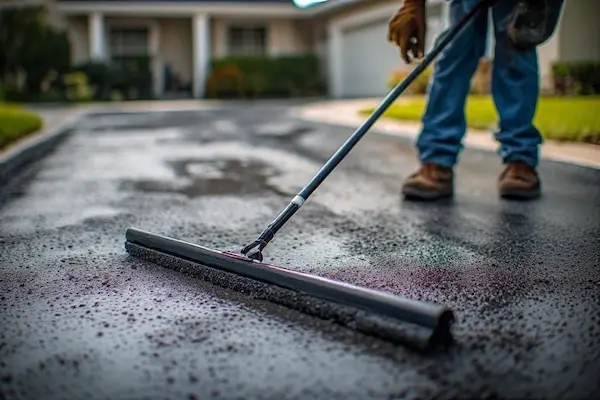
After applying the first coat, you must wait for it to dry before applying the second. This waiting period is a
crucial part of how long to seal driveway projects.
- Minimum drying time: Most standard sealers need 4-8 hours between coats under ideal conditions
(warm, low humidity).
- Factors that extend drying: Cool temperatures, high humidity, thick application, and poor air
circulation can extend this to 12-24 hours.
- Testing dryness: The first coat should be dry to the touch and not tacky before applying the
second coat. It should feel firm when lightly pressed.
This waiting period means that even with fast work, a two-coat job requires at minimum a full day, and often spans
two calendar days.
Phase 4: Second Coat Application (2-3 hours)
The second coat follows the same process as the first, though it often goes slightly faster:
- Light surface prep (15-30 minutes): Check for any debris that may have settled on the first coat.
Lightly sweep if needed.
- Mixing (15-20 minutes): Stir the remaining sealer or mix a fresh batch.
- Application (1.5-2.5 hours): Apply the second coat using the same technique as the first. The
second coat ensures uniform coverage and adequate protection.
- Final inspection (15-30 minutes): Check for uniformity and correct any minor issues while sealer
is wet.
Total second coat time: 2-3 hours of active work.
Phase 5: Final Drying and Curing (24-72 hours minimum)
After the second coat, the real waiting begins. When people ask how long does it take to seal a
driveway, they often mean "when can I use it again?" This phase provides that answer.
- Dry to touch: 2-4 hours after final coat
- Light foot traffic: 24 hours (walk carefully, avoid dragging feet)
- Pet traffic: 24-48 hours (pet claws can mark soft sealer)
- Vehicle traffic: 48-72 hours minimum
- Full cure: 30-60 days for maximum durability
During this phase, protect the driveway from traffic, moisture, and debris. The sealer continues hardening and
bonding with the asphalt.
How Long Does It Take to Seal a Driveway: Total Timeline
Now let's combine all phases to answer the central question: how long to seal driveway from start to
finish?
Minimum Timeline (Ideal Conditions, Small Driveway)
- Day 1 (morning): Pressure wash (1 hour), allow to dry (remainder of day)
- Day 2 (morning): Crack repair, oil treatment, masking (2 hours)
- Day 2 (afternoon): First coat application (2-3 hours)
- Day 2 (evening): Second coat application (2 hours) if first coat dried quickly
- Day 3-5: Final drying before vehicle use
Total active work: 7-9 hours spread over 2 days
Total project duration (start to vehicle-ready): 3-5 days
Typical Timeline (Average Conditions, Medium Driveway)
- Day 1: Pressure wash (1.5 hours), allow to dry overnight
- Day 2: Crack repair, oil treatment, masking (2-3 hours), allow repairs to dry
- Day 3 (morning): First coat application (3 hours)
- Day 3 (evening): Second coat application (2.5 hours) if first coat dried
- Day 4-6: Final drying before vehicle use
Total active work: 9-11 hours spread over 3 days
Total project duration (start to vehicle-ready): 4-6 days
Extended Timeline (Challenging Conditions, Large Driveway)
- Day 1-2: Extensive cleaning, weed removal, pressure washing (3-4 hours spread over 2 days due to
drying)
- Day 3: Extensive crack repair, oil treatment (3-4 hours), allow to dry
- Day 4: Masking (1 hour), first coat application (4-5 hours)
- Day 5: Second coat application (4 hours) after overnight drying
- Day 6-8: Final drying before vehicle use
Total active work: 15-18 hours spread over 5 days
Total project duration (start to vehicle-ready): 6-8 days
These timelines show that how long does it take to seal a driveway varies significantly based on
your specific situation. Always add buffer time for unexpected issues like weather delays or discovery of additional
repairs needed.
How Long to Seal Driveway: Professional vs. DIY Comparison
One of the biggest factors affecting how long to seal driveway projects is whether you hire
professionals or do it yourself. Each approach has different time implications that may influence your decision.
DIY Driveway Sealing Timeline
For motivated homeowners, DIY sealing offers cost savings but requires a significant time investment. Here's what
affects how long does it take to seal a driveway when going the DIY route:
- Learning curve: First-time DIYers work slower as they learn techniques and troubleshoot issues
- Single worker: Most DIY projects involve one person, which naturally extends application time
- Equipment limitations: Basic tools like hand-held squeegees and rollers cover ground slower than
professional equipment
- Physical fatigue: Sealing is physically demanding; breaks are necessary and affect overall pace
- Weather dependency: DIYers with limited scheduling flexibility may work in less-than-ideal
conditions
Typical DIY total time (500-700 sq ft driveway): 10-14 hours active work spread over 3-5 days from
start to vehicle-ready.
Professional Driveway Sealing Timeline
Professional crews complete the same job much faster due to experience, equipment, and manpower. When asking
how long to seal driveway professionally, expect:
- Multiple workers: Teams of 2-4 people divide tasks—preparation, edging, application, cleanup
- Commercial equipment: Professional spray rigs, industrial squeegees, and power washers work
faster
- Experience: Professionals work efficiently without trial-and-error delays
- Streamlined process: Established workflows minimize wasted movement and time
- Better weather planning: Professionals schedule optimally and have flexibility to wait for ideal
conditions
Typical professional total time (500-700 sq ft driveway): 3-5 hours active work, with return for
second coat next day. Total project duration 2-3 days from start to vehicle-ready.
Time Comparison by Phase
| Project Phase |
DIY Time |
Professional Time |
| Pressure washing & cleaning |
1.5-2.5 hours |
30-60 minutes |
| Crack repair & spot treatment |
1-3 hours |
30-90 minutes |
| Masking & preparation |
45-90 minutes |
20-30 minutes |
| First coat application |
2-4 hours |
45-90 minutes |
| Second coat application |
2-3 hours |
30-60 minutes |
| Cleanup |
30-60 minutes |
15-30 minutes |
| Total active work |
8-14 hours |
3-5 hours |
This comparison shows that while DIY saves money, it requires significantly more personal time and extends the period
your driveway is out of service.
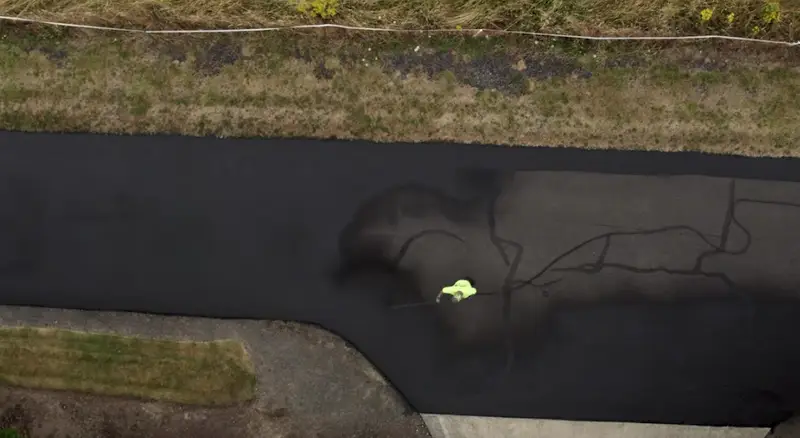
How Long Does It Take to Seal a Driveway by Size
Driveway size is the most straightforward factor in determining how long does it take to seal a
driveway. Here are estimates for different sizes using standard two-coat application with squeegee method
for DIY, and spray method for professionals.
Small Driveway (300-400 sq ft)
Typical for single-car garages or smaller homes:
- DIY: 4-6 hours active work over 2-3 days total
- Professional: 1.5-2.5 hours active work over 2 days total
- Vehicle-ready: 3-4 days from start
Medium Driveway (500-700 sq ft)
Standard double-car driveway:
- DIY: 8-12 hours active work over 3-4 days total
- Professional: 2.5-4 hours active work over 2 days total
- Vehicle-ready: 4-5 days from start
Large Driveway (800-1200 sq ft)
Extra-long or wide driveways, circular drives:
- DIY: 12-18 hours active work over 4-5 days total
- Professional: 4-6 hours active work over 2-3 days total
- Vehicle-ready: 5-6 days from start
Commercial or Extra-Large (1500+ sq ft)
Parking areas, multi-car compounds:
- DIY: Not recommended—would take multiple days of active work
- Professional: 6-10 hours active work over 2-3 days total
- Vehicle-ready: 5-7 days from start
These estimates assume good weather, average condition driveways, and no major surprises. Always add buffer time when
planning your project.
Tips to Reduce How Long to Seal Driveway Projects
If you're concerned about how long to seal driveway and want to minimize downtime, consider these
strategies:
Plan Ahead for Efficient Workflow
- Prepare materials in advance: Have all tools, sealer, and supplies ready before starting
- Check weather thoroughly: Choose a multi-day window with ideal conditions to avoid delays
- Clear schedule: Block off dedicated time without interruptions or other commitments
- Arrange parking: Have alternative parking arranged so you're not rushing the process
Optimize Preparation
- Pressure wash efficiently: Work in systematic patterns, don't rush but maintain steady pace
- Multi-task during drying: While waiting for pressure-washed driveway to dry, prepare tools, read
instructions, and plan application strategy
- Batch similar tasks: Do all crack filling at once, all oil treatment at once, etc.
- Use fast-drying repair products: Some crack fillers dry in 1-2 hours instead of overnight
Speed Up Application
- Enlist help: Even one additional person dramatically reduces application time—one can edge while
the other applies main coat
- Use proper tools: A quality squeegee with extension pole covers ground faster than a roller or
small applicator
- Work in systematic sections: Grid pattern ensures coverage without wasted movement
- Maintain wet edge: Working efficiently prevents having to go back and fix lap marks
Consider Fast-Dry Products
If timeline is critical, choose sealer specifically formulated for quick drying:
- Fast-dry acrylics: Can reduce between-coat drying from 6-8 hours to 1-3 hours
- Commercial-grade products: Some professional formulations cure faster than standard retail
products
- Check labels: Look for "fast dry" or "quick cure" indicators on product packaging
Remember that faster drying doesn't necessarily mean faster curing—the sealer still needs time to develop full
protection even if it's dry to touch.
Common Questions About How Long to Seal Driveway
Even with detailed planning, homeowners often have additional questions about how long to seal
driveway projects. Here are answers to the most frequently asked questions.
How long does it take to seal a driveway if I only have weekends?
Many DIYers can only work on weekends, which affects the answer to how long does it take to seal a
driveway. Here's a realistic weekend-only timeline:
- Weekend 1 (Saturday): Pressure wash and clean driveway. Allow to dry overnight and through
Sunday.
- Weekend 1 (Sunday): Perform crack repair and oil treatment. Allow repairs to dry (some may need
24+ hours).
- Weekend 2 (Saturday): Apply first coat of sealer in morning. Allow to dry 4-8 hours. Apply second
coat in late afternoon/evening.
- Weekend 2 (Sunday): Allow final drying. By evening, light foot traffic可能 possible. Vehicle
traffic by Monday or Tuesday.
This two-weekend approach works well, giving ample drying time between phases. Total project duration from start to
vehicle-ready: approximately 10-12 days.
How long to seal driveway between coats?
This is one of the most common questions about how long to seal driveway projects. The answer
depends on your sealer and conditions:
- Standard sealer, ideal conditions: 4-8 hours between coats
- Standard sealer, cool/humid: 12-24 hours between coats
- Fast-dry sealer: 1-3 hours between coats
- Maximum window: Most sealers require second coat within 24-48 hours for proper chemical bonding.
Check manufacturer specifications.
Always test dryness before applying second coat. The first coat should be dry to touch, not tacky, and firm when
lightly pressed.
How long does it take to seal a driveway before it rains?
This critical safety question affects project planning. For adequate rain protection:
- Minimum safe window before light rain: 4-6 hours after final coat
- Recommended window before heavy rain: 24-48 hours after final coat
- Between coats and rain: Each coat needs similar protection—don't let rain hit partially cured
sealer
Always check forecasts and ensure at least 48 hours of completely dry weather after your planned completion.
How long to seal driveway before parking cars?
The most practical concern: when can you use your driveway again?
- Absolute minimum (risk of marking): 24-48 hours
- Recommended for vehicles: 48-72 hours
- For heavy vehicles or turning tires: 5-7 days
- Full cure before heavy use: 30-60 days
During the first week, park in different spots each time to avoid imprinting the sealer with tire patterns. Avoid
turning wheels while parked for at least 7 days.
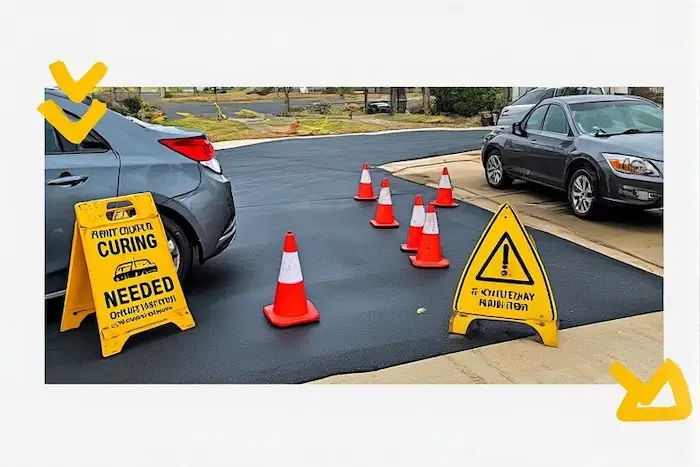
Signs Your Driveway Sealer Is Fully Cured
Beyond watching the calendar, learn to recognize when your sealer has reached key milestones in answering how
long to seal driveway completion.
Visual Indicators
- Uniform color: The surface has consistent deep black color without lighter or darker patches
- No tackiness: The surface appears matte rather than glossy in spots (unless you used a high-gloss
sealer)
- Clear tire tracks: If you must drive on it early, tire tracks should not leave marks or imprints
Physical Tests
- Fingernail test: Press firmly with a fingernail in an inconspicuous spot. It should not leave an
indentation.
- Water test: Sprinkle a few drops of water. They should bead up rather than soak in or leave
marks.
- Adhesion test: Press duct tape firmly, then remove. No sealer should come off with the tape.
Passing these tests indicates the sealer has cured sufficiently for normal use, though full chemical cure continues
for weeks.
Planning Your Driveway Sealing Project
Now that you understand how long to seal driveway projects take, here's a checklist to ensure
success:
Two Weeks Before
- Check weather trends for your area
- Research and purchase quality sealer and tools
- Arrange alternative parking if needed
- Clear your schedule for the projected timeline
One Week Before
- Monitor detailed forecast daily
- Perform initial sweeping and debris removal
- Purchase crack filler and repair materials
- Notify family/neighbors about upcoming project
3-4 Days Before
- Pressure wash driveway
- Begin drying countdown
- Treat any weeds or vegetation
2 Days Before
- Perform crack repairs
- Treat oil stains with primer
- Ensure driveway is completely dry
Day Before
- Mask and protect adjacent surfaces
- Mix sealer if recommended (some need overnight sitting)
- Confirm weather forecast
Day Of
- Apply first coat in morning
- Monitor drying progress
- Apply second coat when ready
- Begin drying/curing countdown
Conclusion
Understanding how long to seal driveway projects take is essential for successful planning and
execution. The total timeline depends on multiple factors: driveway size and condition, preparation requirements,
sealer type, application method, weather conditions, and whether you choose DIY or professional services.
For a typical residential driveway of 500-700 square feet, expect 8-14 hours of active work spread over 3-5 days from
start to vehicle-ready if doing it yourself. Professional crews can complete the same job in 3-5 hours of active work
over 2-3 days total. The key phases—preparation, first coat, drying between coats, second coat, and final curing—each
require respect and adequate time.
Remember that rushing any phase compromises the final result. Proper preparation ensures the sealer adheres
correctly. Adequate drying between coats prevents peeling and ensures uniform appearance. And respecting final cure
times before vehicle traffic protects your investment and delivers the durability you expect.
By planning ahead, gathering the right materials, and allocating sufficient time, you can achieve
professional-quality results that protect and beautify your driveway for years to come. Whether you tackle the project
yourself or hire professionals, knowing what to expect helps you make informed decisions and avoid costly mistakes.
If you need asphalt services in the Gatineau and Ottawa area, you
can contact Pavage Gatineau Earnanswers at +1 (819) 485
1489.
Approved sites
Further reading
Asphalt and Sealing Tips
Parking Lot Maintenance
Other services